Youl Tide Is Here Again Sing
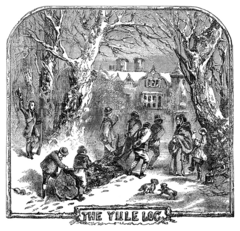 Hauling a Yule log in 1832 | |
| Also called | Yuletide, Yulefest |
|---|---|
| Observed by | Various Northern Europeans, Germanic peoples, Neopagans, Spiritual Satanists |
| Type | Cultural, Germanic Pagan and so Christian, secular, contemporary Infidel |
| Date | December 21 – January 1 |
| Frequency | Annual |
| Related to | Early Germanic calendars, Christmastide, Quarter days, Wheel of the Year, Winter festivals, Christmas |
Yule (also called Jul, Julblot, jól, jólablót, joulu, "Yule time" or "Yule season") is a festival historically observed by the Germanic peoples. Scholars accept connected the original celebrations of Yule to the Wild Hunt, the god Odin, and the infidel Anglo-Saxon Mōdraniht ("Mothers' Night").
Later departing from its pagan roots, Yule underwent Christianised reformulation,[one] resulting in the term Christmastide. Some nowadays-solar day Christmas customs and traditions such as the Yule log, Yule goat, Yule boar, Yule singing, and others may have connections to older infidel Yule traditions. Cognates to Yule are notwithstanding used in the Scandinavian languages as well every bit in Finnish and Estonian to describe Christmas and other festivals occurring during the winter vacation flavor.
Etymology [edit]
Yule is the modern version of Sometime Norse Jól and Jólnir one of the names for Odin. The Sometime English derivates ġēol or ġēohol and ġēola or ġēoli , indicates the 12-day festival of "Yule" (afterward: "Christmastide") and the latter indicating the month of "Yule", whereby ǣrra ġēola referred to the period earlier the Yule festival (December) and æftera ġēola referred to the menstruation afterward Yule (January). Both words are cognate with Gothic 𐌾𐌹𐌿𐌻𐌴𐌹𐍃 ( jiuleis ); Old Norse, Icelandic, Faeroese and Norwegian Nynorsk jól, jol , ýlir ; Danish, Swedish, and Norwegian Bokmål jul , and are thought to be derived from Proto-Germanic *jehwlą- .[ii] [iii] The etymological full-blooded of the word remains uncertain, though numerous speculative attempts have been made to find Indo-European cognates outside the Germanic group, too.[four] The noun Yuletide is beginning attested from around 1475.[5]
The word is conjectured in an explicitly pre-Christian context primarily in Old Norse. Among many others (see List of names of Odin), the long-bearded god Odin bears the name Jólnir ('the Yule one'). In Ágrip , written in the 12th century, Christmas, jól is interpreted equally coming from ane of Odin'south names, Jólni(r) . In poetic language, a plural form (Old Norse jóln ) may also refer to the gods collectively. In Old Norse poetry, the discussion is found equally a term for 'banquet', e.g. hugins jól (→ 'a raven'south feast').[6]
It has been thought that Old French jolif (→ French joli), which was borrowed into English in the 14th century as 'jolly', is itself borrowed from Old Norse jól (with the Old French suffix -if ; compare One-time French aisif "easy", Modern French festif = fest "feast" + -if).[7] But the Oxford English language Dictionary sees this explanation for jolif as unlikely.[8] The French discussion is first attested in the Anglo-Norman Estoire des Engleis , or "History of the English People", written past Geoffrey Gaimar between 1136 and 1140.[ix]
Germanic paganism [edit]
Yule is an indigenous winter festival celebrated by the Germanic peoples. The earliest references to it are in the form of calendar month names, where the Yule-tide catamenia lasts somewhere around two months, falling along the finish of the modern agenda year between what is now mid-November and early January.[10]
Attestations [edit]

Yule is attested early in the history of the Germanic peoples; in a Gothic language agenda of the 5–6th century information technology appears in the calendar month proper name fruma jiuleis , and, in the 8th century, the English historian Bede wrote that the Anglo-Saxon agenda included the months geola or giuli respective to either mod December or December and January.[11]
While the Old Norse month proper noun ýlir is similarly attested, the Old Norse corpus also contains numerous references to an issue by the One-time Norse grade of the name, jól . In chapter 55 of the Prose Edda volume Skáldskaparmál , different names for the gods are given; 1 is "Yule-beings". A piece of work by the skald Eyvindr skáldaspillir that uses the term is then quoted: "again we have produced Yule-beingness's banquet [mead of poesy], our rulers' eulogy, like a bridge of masonry".[12] In addition, 1 of the numerous names of Odin is Jólnir , referring to the consequence.[xiii]
The Saga of Hákon the Proficient credits King Haakon I of Kingdom of norway who ruled from 934 to 961 with the Christianization of Norway also as rescheduling Yule to coincide with Christian celebrations held at the time. The saga says that when Haakon arrived in Norway he was a confirmed Christian, but since the land was still altogether heathen and the people retained their infidel practices, Haakon hid his Christianity to receive the help of the "great chieftains". In time, Haakon had a police force passed establishing that Yule celebrations were to accept identify at the same time as the Christians celebrated Christmas, "and at that time everyone was to have ale for the celebration with a measure of grain, or else pay fines, and had to keep the holiday while the ale lasted."[fourteen]
Yule had previously been celebrated for 3 nights from midwinter nighttime, co-ordinate to the saga. Haakon planned that when he had solidly established himself and held power over the whole country, he would then "have the gospel preached". According to the saga, the result was that his popularity caused many to permit themselves to be baptized, and some people stopped making sacrifices. Haakon spent most of this time in Trondheim. When Haakon believed that he wielded enough power, he requested a bishop and other priests from England, and they came to Norway. On their inflow, "Haakon made it known that he would have the gospel preached in the whole land." The saga continues, describing the different reactions of various regional things.[14]
A clarification of pagan Yule practices is provided (notes are Hollander's ain):
It was ancient custom that when sacrifice was to be made, all farmers were to come to the pagan temple and bring forth with them the food they needed while the feast lasted. At this feast all were to take role of the drinking of ale. Also all kinds of livestock were killed in connectedness with it, horses too; and all the blood from them was called hlaut [sacrificial blood], and hlautbolli , the vessel property the claret; and hlautteinar , the sacrificial twigs [aspergills]. These were fashioned like sprinklers, and with them were to exist smeared all over with claret the pedestals of the idols and as well the walls of the temple within and without; and likewise the men nowadays were to exist sprinkled with claret. Simply the meat of the animals was to be boiled and served as food at the banquet. Fires were to be lighted in the centre of the temple floor, and kettles hung over the fires. The sacrificial beaker was to exist borne around the fire, and he who fabricated the feast and was chieftain, was to anoint the beaker equally well as all the sacrificial meat.[15]
The narrative continues that toasts were to be boozer. The first toast was to be drunk to Odin "for victory and power to the king", the second to the gods Njörðr and Freyr "for good harvests and for peace", and tertiary, a beaker was to exist boozer to the king himself. In improver, toasts were drunk to the memory of departed kinsfolk. These were called minni .[15]
Theories and interpretation [edit]
Scholars have connected the month consequence and Yule menses to the Wild Hunt (a ghostly procession in the winter sky), the god Odin (who is attested in Germanic areas as leading the Wild Hunt and bears the name Jólnir ), and increased supernatural action, such as the Wild Hunt and the increased activities of draugar —undead beings who walk the globe.[xvi]
Mōdraniht , an event focused on collective female beings attested by Bede as having occurred amidst the heathen Anglo-Saxons on what is now Christmas Eve, has been seen as further evidence of a fertility effect during the Yule flow.[10]
The events of Yule are by and large held to accept centered on midwinter (although specific dating is a matter of debate), with feasting, drinking, and cede ( blót ). Scholar Rudolf Simek says the pagan Yule feast "had a pronounced religious character" and that "it is uncertain whether the Germanic Yule feast yet had a function in the cult of the dead and in the veneration of the ancestors, a function which the mid-wintertime sacrifice certainly held for the W European Rock and Bronze Ages." The traditions of the Yule log, Yule goat, Yule boar ( Sonargöltr , still reflected in the Christmas ham), Yule singing, and others possibly accept connections to pre-Christian Yule customs, which Simek says "indicates the significance of the feast in pre-Christian times."[17]
Contemporary traditions [edit]
In mod Germanic language-speaking areas and some other Northern European countries, historical cognates to English yule announce the Christmas holiday season. Examples include jul in Sweden, Kingdom of denmark, and Kingdom of norway, jól in Iceland and the Faroe Islands, joulu in Finland, Joelfest in Friesland, Joelfeest in the netherlands and jõulud in Estonia.
Mod paganism [edit]
As gimmicky pagan religions differ in both origin and exercise, these representations of Yule can vary considerably despite the shared name. Some Heathens, for example, gloat in a way as close as possible to how they believe ancient Germanic pagans observed the tradition, while others notice the holiday with rituals "assembled from different sources".[18] Heathen celebrations of Yule can too include sharing a repast and gift giving.
In nearly forms of Wicca, this holiday is celebrated at the winter solstice every bit the rebirth of the Great horned hunter god,[19] who is viewed as the newborn solstice sun. The method of gathering for this sabbat varies by practitioner. Some accept individual ceremonies at home,[20] while others practice so with their covens.[21]
LaVeyan Satanism [edit]
The Church building of Satan and other LaVeyan Satanist groups celebrate Yule every bit an culling to the Christian Christmas vacation. Yule in LaVeyan Satanism is not celebrated with the same rituals as in contemporary paganism or Heathenry.[22] [23]
Meet also [edit]
- Dísablót , an event attested from Old Norse sources as having occurred amongst the heathen Norse
- Julebord, the modern Scandinavian Christmas feast
- Koliada, a Slavic wintertime festival
- Lohri, a Punjabi winter solstice festival
- Mōdraniht , an issue attested by Bede as having occurred amid the pagan Anglo-Saxons on what is now Christmas Eve
- Saturnalia , an ancient Roman festival in award of the deity Saturn, held on 17 Dec and expanded with festivities through 23 Dec
- Yaldā Dark, an Iranian festival historic on the "longest and darkest night of the year."
Notes [edit]
- ^ "Winter Solstice/Yule". Vancouver Island Academy. 21 December 2019. Retrieved 9 July 2020.
Yule is a festival historically observed by the Germanic peoples. Departing from its pagan roots, Yule underwent Christianised reformulation resulting in the now improve-known Christmastide.
- ^ Bosworth & Toller (1898:424); Hoad (1996:550); Orel (2003:205)
- ^ "jol". Bokmålsordboka | Nynorskordboka . Retrieved 11 March 2017.
- ^ For a brief overview of the proposed etymologies, see Orel (2003:205).
- ^ Barnhart (1995:896).
- ^ Guðbrandur Vigfússon (1874:326).
- ^ T. F. Hoad, English Etymology, Oxford University Press, 1993 (ISBN 0-xix-283098-8).
- ^ "jolly, adj. and adv." OED Online, Oxford Academy Press, December 2019. Accessed nine December 2019.
- ^ Site CNTRL; Etymology of joli (in French)
- ^ a b Orchard (1997:187).
- ^ Simek (2007:379).
- ^ Faulkes (1995:133).
- ^ Simek (2007:180–181).
- ^ a b Hollander (2007:106).
- ^ a b Hollander (2007:107).
- ^ Simek (2007:180–181 and 379–380) and Orchard (1997:187).
- ^ Simek (2007:379–380).
- ^ Hutton, Ronald (Dec 2008). "Modern Pagan Festivals: A Study in the Nature of Tradition". Sociology. Taylor & Francis. 119 (three): 251–273. doi:10.1080/00155870802352178. JSTOR 40646468. S2CID 145003549.
- ^ James Buescher (15 December 2007). "Wiccans, pagans gear up to gloat Yule". Lancaster Online. Archived from the original on 29 Dec 2007. Retrieved 21 December 2007.
- ^ Andrea Kannapell (21 December 1997). "Celebrations; It's Solstice, Hanukkah, Kwannza: Let At that place Be Lite!". The New York Times . Retrieved 21 December 2007.
- ^ Ruth la Ferla (xiii December 2000). "Like Magic, Witchcraft Charms Teenagers". The New York Times . Retrieved 21 Dec 2007.
Mostly meeting in covens, which anoint their own priests and priestesses, Wiccans dirge and cast or describe circles to invoke their deities, mainly during festivals like Samhain and Yule, which coincide with Halloween and Christmas, and when the moon is full.
- ^ "F.A.Q. Holidays". Church of Satan . Retrieved 9 February 2019.
- ^ Escobedo, Tricia (11 December 2015). "5 things you didn't know nigh Satanists". CNN . Retrieved 6 March 2019.
So for the Yule holiday season we enjoy the richness of life and the company of people whom we cherish, as we will often exist the merely ones who know where the traditions really came from!
References [edit]
- Barnhart, Robert K. (1995). The Barnhart Curtailed Dictionary of Etymology. Harper Collins. ISBN 0062700847
- Bosworth, Joseph; Toller, T. Northcote (1898). An Anglo-Saxon Lexicon. Oxford: Oxford University Press.
- Faulkes, Anthony (Trans.) (1995). Edda. Lowest. ISBN 0-460-87616-iii.
- Vigfússon, Guðbrandur (1874). An Icelandic-English Dictionary: Based on the Ms. Collections of the Belatedly Richard Cleasby. Clarendon Printing. OCLC 1077900672.
- Hoad, T. F. (1996). The Concise Oxford Lexicon of English Etymology. Oxford: Oxford University Press. ISBN 0-19-283098-viii.
- Hollander, Thousand. Lee (Trans.) (2007). Heimskringla: History of the Kings of Kingdom of norway. University of Texas Press. ISBN 978-0-292-73061-8
- Orchard, Andy (1997). Dictionary of Norse Myth and Legend. Cassell. ISBN 0-304-34520-2.
- Orel, Vladimir (2003). A Handbook of Germanic Etymology. Leiden: Brill Publishers. pg. 205. ISBN 90-04-12875-1.
- Simek, Rudolf (2007) translated by Angela Hall. Dictionary of Northern Mythology. D.S. Brewer ISBN 0-85991-513-ane
External links [edit]
Source: https://en.wikipedia.org/wiki/Yule
0 Response to "Youl Tide Is Here Again Sing"
Publicar un comentario