Richard Wagner Was Determined to Create a ââåtotal Art Workã¢ââ in Music This Was Known as
 In many of Wagner's theoretical writings, such as "Die Kunst und die Religion" (Art and Religion – 1849), "Das Kunstwerk der Zukunft" (The Artwork of the Future – 1849) and "Oper und Drama" (Opera and Drama – 1852), the concept of the 'Gesamtkunstwerk' — the totality of the work of art — became the central focus , which Wagner subsequently fabricated the basis for his compositions.
According to Wagner, the 'Zersplitterung der Kűste' (the Split between the Arts) had occurred in Greek antiquity, with word, music and dance originally existing in perfect harmony. Initially, in the perfect Greek state, Greek tragedy embodied this harmony, but with the autumn of the 'Athenian Polis', the arts started to diverge. For Wagner, (and this explains his youthful 'revolutionary' fervor during the revolutions of 1848) ane should aspire to create a perfect social club in which the perfect harmony of the work of fine art could again exist.
 Focusing specifically on opera, Wagner criticized many of the traditional opera libretti, in which, he said "the action was a roughly constructed framework which simply existed to poorly motivate pathetic situations" ("… daß die Handlung ein roh gezimmertes Gerüst darstelle, das zu nichts anderem bestimmt sei, als pathetische Situationen notdürftig zu motivieren") — interspersed with arias which dominated the libretto. For him, opera and drama had to exist re-united. Here, he approached Baudelaire's concept of 'synesthesia', which I addressed in my previous Interlude article 'Richard Wagner and Paris', where all of the senses, interim in harmony, are awakened and lead to more profound appreciation and experience.
Richard Wagner: Tristan und Isolde – Act III: Prelude (Bayreuth Festival Orchestra; Peter Schneider, cond.)
Richard Wagner: Tristan und Isolde – Human activity III Scene iii: Mild und leise wie er lächelt (Isolde) (Iréne Theorin, soprano; Bayreuth Festival Orchestra; Peter Schneider, cond.)
 In the start of the 19th century, the Romantic movement in literature and the arts, which influenced Wagner'southward ideas of the 'Musikdrama', had already diverged from the static, classical art forms of the 18th century (the 24 hour rule, the unity of time, action and space — encounter my previous Interlude article on 'The Classical Age in Literature, Art and Music'). In his vision of the Gesamtkunstwerk, Wagner saw it as his mission to reunite the arts — music and fiction, enhanced past dance and gesture, were to exist fully developed, and on an equal basis. The music of the orchestra should express messages appealing to the listener'due south subconscious which then elicits emotional reactions, enhanced by the sensuality of accompanying gestures and trip the light fantastic toe. Music and discussion are and so unified in what Wagner called, "Versmelodie" (melody of verse), i.e. the unification of spoken elements and poetic, musical creation. Whereas spoken language alone addresses the intellect and music evokes feelings, the "Versmelodie" creates a synthesis betwixt both, "… specifically between absence and presence, between intellect/thought and feeling" ("In der Versmelodie verbindet sich nicht nur dice Wortsprache mit der Tonsprache, sondern auch das von diesen beiden Organen ausgedrűckte, nämlich das Ungegenwärtige mit dem Gegenwärtigen, der Gedanke mit der Empfindung", Richard Wagner, Oper und Drama, p. 338). Wagner then created musical 'leitmotifs', specific to characters and situations which create a unity within the piece of work and other works to follow. A practiced example is the leitmotif for Tristan in 'Tristan und Isolde', where the so-called 'Tristan accord', bitonal in graphic symbol, constantly changes from major to minor keys, and and then reflects the ambivalence and changes of Tristan'southward hidden feelings. We tin consider Wagner's 'leitmotifs' as audio-visual controls, in that they evoke in the listener the foreboding of actions to come or remembrances of deportment which have already occurred ("Der lebengebende Mittelpunkt des dramatischen Ausdruckes ist die Versmelodie des Darstellers: auf sie bezieht sich als Ahnung die vorbereitende absolute Orchestermelodie; aus ihr leitet sich als Erinnerung der Gedanke des Instrumentalmotives her" p. 349). Wagner'southward 'leitmotifs' create emotional guideposts throughout his operas and seem to construe activeness in an internally motivated way – this applies particularly to his 'Band' bike.
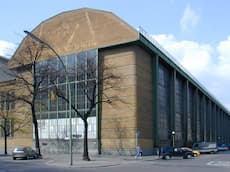
AEG Turbine Factory designed by Peter Behrens
© metalocus.es
Information technology is in this sense that we tin can make the connection to Marcel Proust's writing, and specifically to his epic work 'A la Recherche du Temps Perdu' (In Search of Lost Time). Proust was an ardent admirer of Wagner and we find many references to Wagner in his novels. 'La petite Sonate de Vinteuil' in 'Du Côté de Chez Swann' ('Swann'southward Mode') is the leitmotif for Swann's love for Odette, simply after reappears as the leitmotif in the relationships betwixt the narrator and Albertine, and Gilberte, Swann's daughter. Here too, the stardom is made betwixt intellect and feelings:
 "Et le plaisir que lui donnait la musique (….) ressemblait en effet, à ces moments-là, au plaisir qu'il aurait eu à experimenter des parfums, à entrer en contact avec un monde (…) qui nous semble sans forme parce que nos yeux ne le perçoivent pas, sans signification parce qu'il échappe à notre intelligence…"
(And the pleasance which music gave him (…) at those moments resembled in result the pleasance with which he would experiment in scents/perfumes, to enter into contact with a world (…) which seems to us without form, because our optics do not perceive it, without meaning, because it escapes our intelligence…)
 For Proust, merely as for Baudelaire and Wagner, this stardom between intellect and feelings has to be overcome through the entreatment to the senses, which allows him, and in turn the reader or listener, to access this other world — the world of art, music, painting and literature. Whether information technology is the 'Sonate de Vinteuil', the 'Madeleine steeped in the cup of tea', the 'paintings of the Impressionist painter, Elstir' (who proclaimed similar Monet, "not to pigment the object, merely the outcome it produces"), the 'uneven steps in the street recalling the beauty of Venice', their very essence and recurring memory (leitmotifs) become the search and recovery of lost time — which then in turn, for Proust, becomes the act of writing — the act of creation. The recurring themes/leitmotifs in Proust's cyclical novel replicate those in Wagner'southward Band bike, 'Der Ring des Nibelungen'.
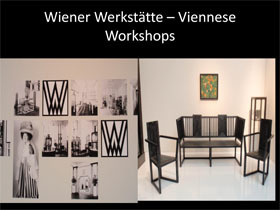
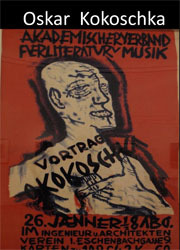
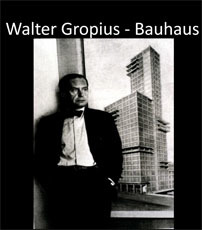
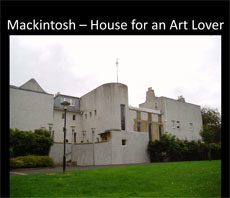
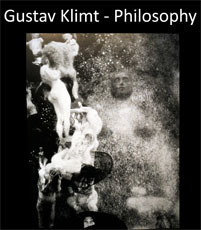
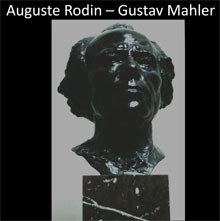 Wagner's concept of the Gesamtkunstwerk also influenced many other artists of the 19th and 20th centuries. The Craft Movements in Scotland (Charles Rennie Mackintosh) and England (William Morris), the Wiener Werkstätte (Viennese Workshops) in Austria (Gustav Klimt, Josef Hofmann, Otto Wagner and Adolf Loos), the Bauhaus (Walter Gropius in Dessau/Weimar — later in Berlin and Chicago) and the Secession in Dresden (Dice Brücke – The Bridge), all were concerned with the situation of the artist-craftsman in the newly and speedily developing industrial order with its production of ready-made products which would threaten their art and livelihood. All of their efforts were directed toward re-creating an artistic surround where all of the arts would come together. The architecture of their fourth dimension (the architect Peter Behrens would speak of his Turbine Factory) as a cathedral in steel and drinking glass) would now reflect their artful non only on the exterior, just within their museums, private houses, shops and cafés as well, in which all elements were coordinated and furniture, fabrics, housewares, books, jewelry and dress created a beautifully integrated environs. Oskar Kokoschka'southward poster advertises a speaking appointment on literature and music (fifty-fifty though Kokoschka was a painter), and Gustav Klimt paints his vision of philosophy, basing it on Nietzsche'south Midnight Song in 'Zarathoustra'—"Oh Mensch, gib acht, was spricht dice tiefe Mitternacht …" (O homo accept heed, what does the deep midnight say…), which Gustav Mahler then uses in his Tertiary Symphony.
In those glorious years of the Fin-de-Siècle culture many of these architects, artist-craftsmen, painters, writers and musicians would follow Wagner'due south inspiration, creating objects of dazzler in their respective fields, reaching across different domains, and, in every sense, achieving the concept of the 'Gesamtkunstwerk'.
For more of the best in classical music, sign upward to our E-Newsletter
Source: https://interlude.hk/richard-wagners-concept-of-the-gesamtkunstwerk/
0 Response to "Richard Wagner Was Determined to Create a ââåtotal Art Workã¢ââ in Music This Was Known as"
Publicar un comentario